
Condo Vs. House & Lot – Is One Better Than The Other?
For many Filipinos, owning property is at the peak of their dreams. A house where they can settle in, a home where they can start

Agropolis,” a portmanteau of “agriculture” and “metropolis,” was first used to describe the vision of Damosa Land, Inc. (DLI) about a decade ago.
The real estate company endeavored to establish an agricultural metropolis in Mindanao — a unique value proposition to set it apart from other property developers in the region. Armed with a vast land bank and a strong presence in the agricultural sector through a sister company that exports bananas worldwide, DLI embarked on conceiving of and building mixed-use communities seeking to redefine the way firms can do business south of the country.
Chief development officer Ricardo “Cary” Floiredo Lagdameo says agriculture is deeply rooted in the company’s DNA. DLI and global banana exporter Tagum Agricultural Development Company, Inc. (TADECO) belong to the group of companies under Anflo Management and Investment Corporation (ANFLOCOR). The banana plantation has been operating since the 1960s and the executive describes it as their “bread and butter business.”
Neither the dip in the industry’s performance nor the reported loss of interest among younger generations to pursue careers in the field dissuaded DLI from pursuing its agropolis dream. “It’s unfortunate that agriculture has really taken a backseat among the industries we have,” Lagdameo says. “We want to try to do our part in reversing the whole trend in (the industry). That’s why we are trying to focus on it.”
DLI traces its roots to Davao Motor Sales (Damosa), a Ford car dealership that Don Antonio O. Floirendo Sr. opened in 1948 after the Second World War. When the automotive company pulled out of the Philippines in 1984 despite its success, Floirendo Sr. turned his focus to the real estate industry.
“We started doing commercial and office development because of the land bank we amassed through the dealership,” explains the Columbia Business School Master of Business Administration degree holder. “We had a lot of properties and many buyers were using their land as collateral. That’s how we built up our land bank and started with our first project. We ventured into residential, horizontal, and condominium projects. We also have hotels in Davao and General Santos City.” Damosa was officially renamed DLI in 2004.
An agricultural metropolis is not the first innovative concept DLI brought to Mindanao. The company also owns the first accredited Philippine Economic Zone Authority (PEZA) Information Technology park in the region. Called Damosa IT Park, the property is now home to IT firms, corporate offices, and a business process outsourcing company.
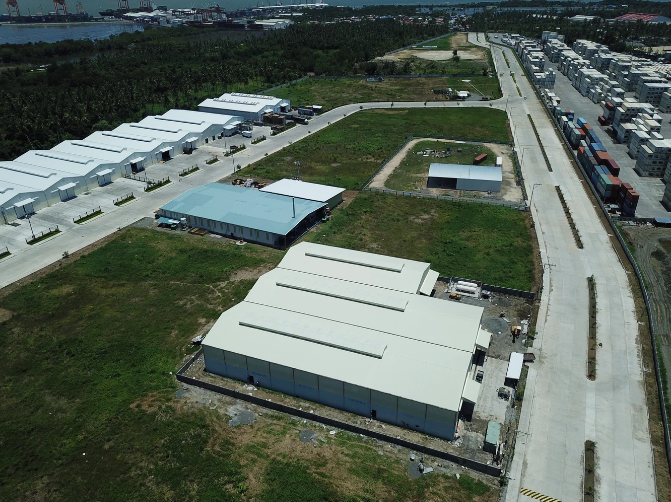
According to Lagdameo, DLI is keen to promote agriculture not just through farming but “in ways that people can understand it.” Its Anflo Industrial Estate is a 63-hectare self-sustaining ecozone that has manufacturing, cottage industries, warehousing, and agroindustrial operations facilities. There are 62 lots for sale or lease and ready-built, standard factory buildings.
“Unlike the PEZA zones you see in Luzon that focus on manufacturing, electronics, etc., we chose to really focus on agro-industrial properties,” he declares. “We’re encouraging companies that locate there to do food manufacturing, manufacturing of materials that relate to the agriculture business like packaging. Everything has a handle towards agribusiness and no one had really been doing that.”
The agro-industrial hub opened in 2016 and presently has 14 locators.
Already within are Japanese company Packwell, Inc., producer of packaging materials for food businesses like the renowned Godiva-brand chocolate; plastic processing Dutch company Phildutch Polymer, Inc.; Chinese firm and plastic packaging for fresh produce firm Davao Zhenzhi Plastics Corp.; and Filipino firms Del Monte Fresh Produce Philippines that has warehouse and storage facilities in the compound; frozen banana products exporter First Panabo Tropical Foods Corp.; and manufacturing company Manly Plastic, Inc.
“Why we like this kind of business so much is because we affect directly the farmers,” Lagdameo avers. “You take out the middle man because these companies will buy the products at a higher price. They’re processed, so there’s higher value added; and then exported through our port also, which is located right next door. Now, it becomes more efficient for SMEs (small and medium-sized enterprises), and agribusiness companies to be able to export.”
The former investment banker says that aside from close proximity to the port, access to raw materials in Mindanao has proven attractive to clients. “Mindanao is the food basket of the country, and the Davao region is number one for banana production,” he asserts. In a presentation, DLI says 40 percent of the country’s food requirements and 30 percent of national food rate originates from the region.
DLI has also ventured into mixeduse development through township projects like Agriya, an 88-hectare sprawl located in Panabo City, Davao del Norte. “It’s predicated on agriculture,” underscores Lagdameo. “We signed a MOA (Memorandum of Agreement) with the University of the Philippines-Los Baños (UPLB). They’re one of our anchor locators and they’re putting up a campus development.”
By having the country’s premiere agricultural institution, he says DLI hopes to retain talent in Mindanao. “We’re hoping that with this campus, they can still work, go to school. And they don’t have to leave their families or spend to relocate. We also don’t run the risk of them not coming back. A lot of times, you want to stay already in Luzon or from there, maybe go abroad. Maybe we help to try to prevent brain drain.”
Aside from residential, commercial, and institutional components, the executive says agritourism is also programmed in the property. “We’re showcasing different types of farming, products that are very important to the local economy such as banana, aquaculture, high-value crops. To an extent, we will also teach people how to do urban farming, so that when they buy their homes, they can also do their own farming within their lots.” The technology that will be applied to the property is done by in-house, all-Filipino agriculturists and experts.
Lagdameo insists he counts on DLI’s homecourt advantage in Mindanao, predominantly in Davao, to bring in investors. The task has not always been straightforward, Lagdameo admits. But the company’s reputation and knowhow of the local scene give the firm an edge, especially against bigger players.
“We focus on the fact that our logistics and network are both very good there compared to other parts of the country,” he points out. “The cost of doing business is lower because labor cost is less; power cost is less; manpower is abundant. In the Davao region, peace and order is very good. We tell investors, ‘Look, just come down to Mindanao.’ Our experience is that once they step foot in Davao and they see what we have, what the city has to offer, then their mindset changes drastically.
“We capitalize on the fact that we are one of the oldest business groups; that our other businesses have been successful,” he adds. “These have been providing jobs to many people. The goodwill is very strong. I think being pioneers, doing things that are not always traditional (such as) coming out with different ideas, like putting agriculture into our projects is something that’s unique. We’re not the biggest company, so we always have to figure out what’s our niche.”
Lagdameo says that in the last five years, the DLI has moved up from being the 13th to fifth highest contributor to ANFLOCOR. According to his profile, the company had achieved an annual revenue growth of 500 percent between 2013 and 2018.
Next to comprise DLI’s pioneering streak in Davao is a 15-story office tower inside Damosa IT Park, the Damosa Diamond Tower. Lagdameo says the property will be the tallest pure-office building in the city, as other high rises are either hotels or residential developments. The building will run on sustainable technology and is to feature an architectural play of agriculture in its design, too.
Lagdameo shares that the exterior of the tower, slated to open by the first quarter of next year, will showcase a “wavy” feature. “It’s really going to play with lights, but it basically resembles banana and abaca fibers. Even in our office projects, we’re putting a story behind them. We hope that it will be a landmark in the city.
“We like superlatives,” says Lagdameo. “We like be the first, the biggest, the best. Not to brag so much but it’s a fact: We are the first to have an operational industrial park in the region; the first to bring a major co-working or flexible workspace.
“Our roots are really in Mindanao, and they’ve been there for decades. We’re innovative and we always want to have that first-mover advantage. I think we’ve become known for that. We’ve been able to do it because we’re from here. Our ability to take risks is probably a little bit more than other companies.”
Original Article Posted in Philippine Star on November 29, 2019
Written By: Joyce Reyes-Aguila
Article Link: https://pressreader.com/@nickname14058235/csb_1XPHIXbEi4MLordQroyxd_wd4RMfgz93LyrGQUeL3AsLVvrZ8t_QTTo_MUGuAUE6
For many Filipinos, owning property is at the peak of their dreams. A house where they can settle in, a home where they can start

By Amy R. Remo Published On Philippine Daily Inquirer on July 24, 2021. It has certainly been a rough ride, to say the least, for

Published On The Mindanao Times, June 23, 2021 HOMEGROWN property developer Damosa Land Inc. has continued to expand the offerings of its Anflo Industrial Estate